Top martech trends every digital agency should keep an eye on in 2025


Martech is evolving faster than ever, fueled by the rise of generative AI, sweeping privacy regulations, and the collapse of third-party cookies. For digital agencies, adapting isn't optional. It's the difference between leading the charge and lagging behind.
By 2025, the marketing technology stack will be more intelligent, privacy-centric, and deeply interconnected. Agencies that embrace these shifts early will be best positioned to deliver smarter, more compliant, and highly personalised campaigns.
Here’s what’s coming next, and how your agency can stay ahead.
Here's what's next, and what agencies can do.
1. AI-driven personalisation without third-party data
AI is no longer just a tool for automation, it’s becoming the backbone of how agencies understand, engage, and convert audiences. With third-party cookies on the way out, brands must rely on smarter use of first-party and zero-party data to fuel personalisation.
According to Salesforce’s 2023 State of Marketing Report, 68% of marketers say AI helps them personalise customer experiences.
What's changing?
- Predictive AI models will forecast customer intent with greater accuracy - without needing third-party tracking.
- AI-generated content will power everything from ad copy and email subject lines to full blog posts.
- Smart virtual assistants and chatbots will handle deeper, more complex interactions.
- New AI-based personalisation tools will analyse user behaviour in real time - completely cookie-free.
How agencies can stay ahead:
- Use AI for predictive segmentation and personalisation based on user actions, not third-party profiles.
- Experiment with generative AI to scale high-quality content production, without compromising on brand voice.
- Pilot AI in high-impact areas like campaign bidding, email sequences, and lead qualification.
- Build internal guidelines around ethical AI use to maintain transparency and customer trust.
2. Privacy-first marketing and first-party data collection
With increasing privacy worries and laws such as GDPR and CCPA, agencies can no longer rely on third-party tracking. They will instead have to discover new means of gathering and utilising data without sacrificing user trust.
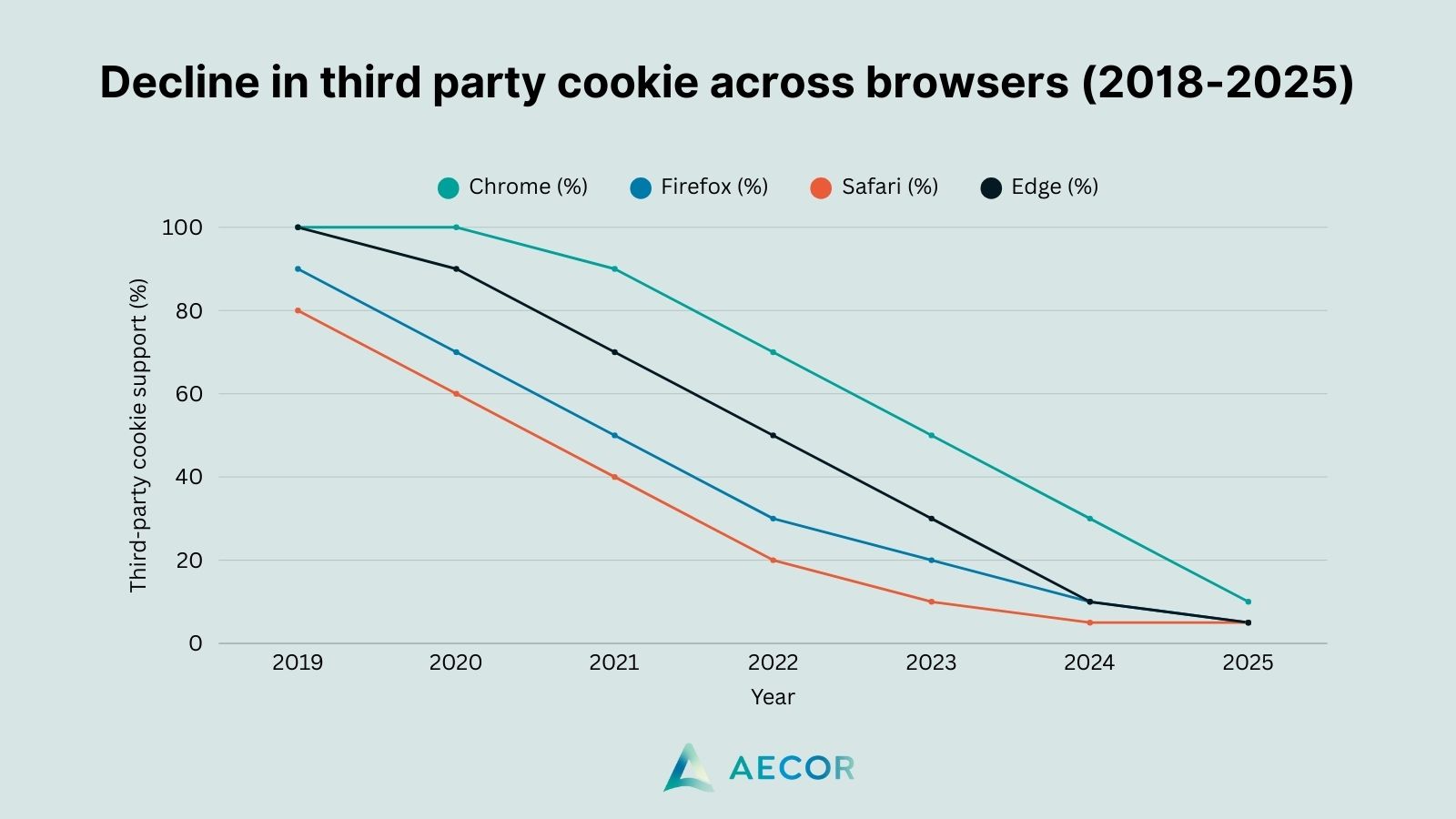
According to HubSpot, 85% of marketers say first-party data is critical to their growth strategy and Google’s planned deprecation of third-party cookies in Chrome by Q3 2024, as outlined in their Privacy Sandbox update, makes this more urgent than ever.
What's changing?
- Third-party cookies are being phased out in major browsers, led by Google Chrome.
- Agencies are shifting to server-side tracking and other privacy-compliant solutions.
- Consumers are increasingly willing to share zero-party data, but only if they trust the brand.
How agencies can stay ahead:
- Emphasise direct audience interaction with email subscriptions, loyalty programs, and surveys.
- Move to server-side tracking for better data fidelity across platforms.
- Build privacy into the core of your strategy, ensure consent-first policies are in place and visible.
- Educate clients about the value exchange behind data sharing.
3. No-code and low-code martech tools
The push for flexibility and speed is behind the use of no-code and low-code platforms. These enable agencies to develop automation, dashboards, and campaign workflows without developers.
Gartner forecasts that by 2025, 70% of new business apps will be built using no-code or low-code technologies.
Why it matters:
- Allows agencies to deploy campaigns quicker with drag-and-drop features.
- Decreases dependence on IT teams for configuring integrations.
- Saves money by avoiding redundant development work.
How agencies can stay ahead:
- Experiment with no-code CRM and marketing automation software to streamline operations.
- Implement low-code platforms for landing pages, portals, and workflows.
- Streamline repetitive work with no-code integration tools.
4. Customer data platforms (CDPs) for smarter insights
Fragmented data leads to fragmented experiences. Enter CDPs: powerful platforms that unify customer interactions across channels into a single, intelligent system, driving smarter decisions and stronger personalisation.
According to the CDP Institute, 73% of marketers using CDPs say the platform has helped them unify customer data across channels.
What's changing?
- CDPs are integrating AI and real-time analytics to uncover deeper insights.
- Agencies are centralising data from sales, marketing, service, and product teams into unified customer profiles.
- Real-time personalisation based on live data is now not just possible, but expected.
How agencies can stay ahead:
- Invest in a CDP that fits your client profile, don’t overcomplicate.
- Use AI-driven insights to predict churn, identify upsell opportunities, and personalise in real time.
- Connect CDPs to your marketing automation stack to execute seamlessly.
- Use built-in consent and privacy controls to align with regional regulations (e.g. GDPR, CCPA).
5. Automated content creation and campaign execution
Manual content generation is holding agencies back. AI-powered tools are filling the gap to accelerate writing, design, and video production, allowing creative output to be scaled more easily.
According to Marketingprofs, 35% rely on AI technologies for content production and optimisation.
What's changing?
- AI content generation tools are churning out blog articles, social media posts, and ad copy.
- Video automation platforms are enabling brands to produce engaging video content rapidly.
- AI-aided design tools are optimising ad creatives, website visuals, and branding.
How agencies can stay ahead:
- Leverage AI-based tools to create content at scale.
- Incorporate AI into current martech stacks to minimise manual campaign labour.
- Keep human oversight to preserve messaging on-brand.
6. Conversational marketing and AI chatbots
Consumers want immediate responses, and conversational marketing technologies, such as AI chatbots and voice assistants, are making real-time interaction more accessible than ever.
Drift’s reports that 58% of companies in the B2B sector actively use chatbots, compared to 42% of B2C companies.
Statista reports that over 8.4 billion voice assistants will be in use globally by 2024.
What's changing?
- Chatbots are managing more sophisticated customer service and sales inquiries.
- Voice search is defining the way individuals find brands online.
- Automated customer service is cutting costs while enhancing response times.
How agencies can stay ahead:
- Use AI-powered chatbots to address FAQs and lead nurturing.
- Optimise content for voice search queries to increase visibility.
- Leverage chatbots with CRM and marketing automation platforms.
Final thoughts: Preparing for martech in 2025
2025 will reward the bold, the data-smart, and the relentlessly adaptive. Agencies that embrace AI, lean into privacy-first thinking, and unify their tech stacks will outperform those stuck in the past.
From predictive AI and no-code tools to ethical data strategies and hyper-personalised customer journeys, the future isn’t just coming, it’s already here.
At Aecor Digital, we help agencies like yours take advantage of what’s next, without the guesswork. Whether it’s CDP integration, chatbot development, automation workflows, or AI content strategies, our expert team delivers tailored martech solutions that drive results.
Ready to future-proof your agency? Let’s talk about how Martech can serve you better in 2025. Let’s talk!


Not sure where to start?
That is exactly what the first call is for.
30 minutes. No pitch. Just a practical conversation about what you are trying to solve and whether we are the right people to help.
“Aecor built our new web-based events platform with total professionalism and diligence. A great software development partner to work with.”

“Aecor has powered our growth to 5M+ users across desktop and mobile. Professional, reliable support at every stage.”

“Extremely passionate and professional from day one. A first-class service, both technically and commercially.”

“Aecor’s agile approach let us refine requirements as we went. Knowledgeable, professional, and still a valued partner today.”

“Aecor is our trusted technology partner for the long run. Solid expertise across every stack our business needs.”

“An outstanding experience with clear communication throughout. Delivered first-class, on time and on budget — beyond expectations.”

“Aecor has been our dedicated dev resource for years. Professional, knowledgeable, and great to build with.”

Book your free consultation